

Supply chain resilience is important — nay, critical — because supply chain disruptions have always happened and will keep happening.
Before the COVID-19 pandemic in the early 2020s, on average, companies experienced a one-to-two-month disruption every three and a half years or so — a cadence that has since accelerated sharply. Global supply chain disruptions increased 38% in 2024 compared to the prior year, and a 2025 Maersk survey of 2,000 shipping customers found that 76% experienced disruptions that delayed their business operations in the past year — with 22% reporting more than 20 disruptive incidents in that same period.
In the new normal, we can expect that disruptions will happen at least as often as they did pre-pandemic, if not moreso. These increasing disruption rates can be attributed to increasingly complex global supply chains; increases in inclement weather related to climate change; geopolitical disruptions that can impact lengthy supply chains; and other challenges that will ultimately arise because of developing markets, products and technologies. Although so many of these events are out of any one company's control, companies can regain some leverage by building their supply chain resilience.
What is Supply Chain Resilience?
Supply chain resilience is a company's ability to navigate unexpected supply chain disruptions with its existing capabilities. In other words, it’s the ability to react to problems and recover from them without significantly impacting operations and customer timelines.
What is Supply Chain Resilience?
When disruptions do occur, they can be catastrophic for not only operational excellence and employee morale but for the company's bottom line. Supply chain disruptions can cost an organization 45% of a year's profits throughout the course of a decade.
But a focus on resilience will have payoffs of its own. A 2021 study by Boston Consulting Group across a variety of industries found that resilient companies outperformed competitors in times of crisis on relative total shareholder return. In stable quarters, the gap between 25th percentile companies and 75th percentile companies was about 16 percentage points. However, in crisis quarters, this gap widened to 30 percentage points. This means that resilient companies nearly doubled their lead over competitors that did not focus on resilience as much.
Resilient companies also tend to experience weaker shocks from disruptions, can recover faster, and might even end up performing better than they did pre-disruption.
How to Build a Resilient Supply Chain
One of the hallmarks of supply chain resilience is change. Building supply chain resilience requires changing and updating current processes and practices to address current challenges. But this is not a one-and-done project. As the world and global markets evolve, supply chains must also keep changing to keep up with them. And as new challenges arise, companies need to adjust their supply chain resilience plans to stay ahead of the upcoming risks.
For now, this means that companies need to make changes to their approaches to the three core enablers of supply chain resilience: processes, people, and technology.
Processes
Companies need to rewrite their supply chain playbooks and, in some cases, toss aside old best practices in favor of new ones. For decades, businesses have focused on minimizing costs, reducing inventory, and increasing asset utilization instead of protecting supply chains from production-halting disruptions and bettering flexibility. Consequently, many were unprepared for the shockwaves from a global crisis.
Several key supply chain management processes are evolving:
.jpg)
1. Forecasting
Current approaches to forecasting link sales requirements to operations, raw materials, and component availability to predict future demand and ensure that an organization can operate to deliver on that demand. But with increasingly complex global supply chains, companies need more than just these cross-functional insights within their own four walls. They need end-to-end supply chain visibility to peer into the demand and risk forecasts for their supply chain partners, too.
Most practically, it helps to know about current lead times for your suppliers and what risks might cause interruptions and delay that timetable. A challenge at one supplier can have ripple effects across the rest of the supply chain, causing each subsequent link to experience delays and fail to meet forecasts.
Achieving end-to-end supply chain visibility can be a roadblock for organizations working toward supply chain resilience. Some companies are still operating within silos in their own companies. End-to-end visibility involves breaking down those walls and then creating transparency between you and your suppliers. It's critical to build trust among all key stakeholders and increase collaboration to share relevant insights.
Furthermore, the level of supply chain visibility an organization achieves directly relates to its ability to weather the next supply chain disruption. This means that the greater the visibility, the better the outcomes.
That gap between ambition and execution remains wide. A 2025 survey of 300 mid-market manufacturers and distributors by Eide Bailly found that only 45% had made active efforts to improve their end-to-end supply chain visibility over the prior year — which means the majority still haven't. The organizations that have invested in visibility report concrete returns: better inventory planning, reduced expedited freight costs, and improved demand forecasting that puts the right goods in the right places at the right times.
The tools manufacturers are turning to reflect how seriously the industry is taking the challenge. A 2025 ABI Research survey found that over 90% of supply chain leaders plan to use AI to improve forecasting accuracy within the next two years. These tools help manufacturers anticipate market changes and proactively respond to them. They may use the data to preorder supplies, increase safety stock, or increase capacity to meet future demand.
2. Inventory Management
For years, a best practice for inventory management has been a just-in-time approach. The idea is that an organization or facility carries enough stock to meet demand — known as cycle stock — plus some buffer stock to cover demand surges, production interruptions, or operational delays. Carrying more than you need means that you are unnecessarily tying up capital and space in stock that you don't need right away.
However, in an age of supply chain disruptions and longer lead times, companies need to shift to a more conservative inventory management strategy that includes more buffer stock.
Toyota Motor Corp., credited as the inventor of the just-in-time strategy, changed its own rulebook as result of the multilayer ceramic capacitor (MLCC) shortages. Toyota directed its suppliers to increase their semiconductor inventory levels from three months to five months. Although this strategy shift technically made the company less efficient in terms of inventory management, Toyota continued to churn out record-breaking profit levels and a record monthly output level following the change.
That picture has continued to shift: McKinsey's 2025 supply chain risk survey found that 45% of companies facing tariff-related disruptions have since turned to inventory buffering as a primary mitigation strategy.
Investments in optimized inventory strategies are worth considering to drive order flexibility and service-level performance. These include management of long lead times; inventory positioning; safety stock to counter unexpected demands; and dynamic, localized replenishment models to ensure materials are delivered exactly when they are needed — not simply when they're forecasted to be needed.
3. Supplier Relationship Management and Sourcing
It’s important to follow a clearly defined sourcing strategy linked to supply chain risks, not just costs. Make sure you have a good reason for working with specific suppliers. Stay away from single-source relationships unless absolutely necessary, and work to expand your supply network to reduce supply chain risk.
Recent supply chain disruptions have significantly accelerated interest in reshoring and nearshoring to shorten supply chains, thus reducing lead times and the risk of interruptions. What was once a cautious consideration has become a mainstream strategic priority: Bain & Company's 2024 biennial operations survey found that 81% of CEOs and COOs had plans to bring supply chains closer to market, up 18 percentage points from just two years prior. The friction points — local capacity constraints and the cost of vertically integrating manufacturing — remain real, but they’re no longer the dominant story.
By 2025, tariffs and geopolitical pressure also pushed companies further toward nearshoring: McKinsey's 2025 supply chain risk survey found 82% of supply chain leaders reported their operations were affected by new tariffs, with 39% pursuing dual sourcing strategies and 33% actively developing nearshoring or onshoring plans in response.
Effective supplier relationship management also can help companies unlock key competitive advantages. Working with suppliers has to be more than just a transactional relationship. Strong supplier relationships have always been important, but in times of supply-demand imbalances, strong relationships are critical. During tough times, suppliers often prioritize deliveries of scarce materials to long-term, reliable partners. The timing challenge is that these relationships need to be established in good times for customers, not when customers are in a bind. Strong relationships are built over the course of years through site visits and data sharing.
The mantra we use at ww5 is to treat supplier partners like a customer, and this approach has worked well for us the past decade. We take the time to get to know them deeply: their leadership, their capabilities, their challenges and their goals. When we have the capacity, we help them with their pain points and do what we can to help them reach their goals.
We collaborate with them on innovation and mutually share data to show how we contribute to each other's successes. Building this level of trust and collaboration contributes to strong relationships. For the most critical suppliers, this should be taken a step further by establishing C-suite-level relationships between the two companies. This elevates the importance of the relationship and makes both companies feel mutually respected and like they are a priority to the other.
.jpg)
4. Commodity Management
Pinpoint the commodities that are most critical to the products and goods you produce. Once you've identified those commodities, build your strategy around them so you can be assured of supply when the inevitable next disruption happens. The goal of your commodity management strategy should be to work toward establishing cost leadership, which is particularly challenging with inflation and component shortages.
Still, investment in a commodity management structure can end up paying for itself many times over. That is if you can ensure the right components are in the right place at the right time at the right price – in spite of the headwinds you may face.
People
Companies need enough manpower to complete the work, but they also need skilled workers with the knowledge to help their employers tackle tough challenges. According to the 2025 MHI and Deloitte Annual Industry Report, hiring and retaining qualified workers along with managing the talent shortage remain the top internal supply chain challenges, vexing 52% and 45% of leaders respectively. That finding has held consistently across the MHI/Deloitte research series for years.
As supply chains transform, it's increasingly difficult to find anyone with some — if any — knowledge about the latest and greatest technology or strategies. As they wade into uncharted territory, most companies and employees will have to learn as they go.
This means companies should address talent acquisition through the lens of preventing future supply chain disruptions and seek out employees with the potential to support their organizations. Scout for knowledgeable engineers, procurement specialists, and supply chain managers who can both supplement existing talent and help the company navigate a difficult business environment. Concurrently, look for people with market knowledge who can help the company stay ahead of market trends. Manufacturing will never slow down, so you need the right people to help you keep up with the pace of business.
Once you have the talent you need, structure your organization for success. Organize a commodity management team and a supplier relationship team. Commodity managers focus on short-term goals and should be experts in their specific commodities markets. This means they’re constantly aware of new products, supply chain developments, pricing changes, and other market activities. Such awareness can help mitigate issues related to cost increases and component shortages.
Supplier relationship managers work with a long-term technology roadmap. These individuals don’t handle price negotiations or the short-term business of their commodity counterparts. Instead, they’re focused on building relationships with suppliers at the executive level by understanding their core business strategies and proactively approaching these partners with mutually beneficial opportunities.
Companies are recognizing the value of these relationships to their overall supply chain strategy. Deloitte's 2025 Global Chief Procurement Officer Survey found that 61% of CPOs rated enhancing supplier collaboration and information sharing as the most effective risk mitigation strategy available to them.
At the same time, it’s important to remember that your employees are more than just workers. They’re people, too. Just as you want to build relationships with your suppliers and be a customer of choice, you want to be an employer of choice for your employees. Still, some companies may have very little wiggle room in their operations and budgets to extend more benefits or hire an ideally sized team to support all operations with extra breathing room. In those cases, companies should consider partnering with a manufacturing solutions provider, which can help enable supply chain resilience.
Technology
Technology can help employees complete the above-mentioned processes more easily and accurately. It allows organizations to bolster their supply chain resilience by staying ahead of challenges and trends as well. For example, real-time analytics and decision-support tools, including enterprise resources planning and electronic data interchange platforms, can help provide baseline data, which, in turn, justifies investments in spend, supplier and commodity analyses.
Together, these provide enriched data sets that can help managers better understand the dynamics of the procurement process; make decisions related to customer needs, production schedules, logistics and delivery requirements; anticipate upcoming challenges, including shortages; and respond quickly to market shifts.
Today's digital economy demands a new approach to manage the entire supply chain ecosystem, known as supply chain digital transformation. According to McKinsey & Co., this involves "employing analytics, artificial intelligence, robotics, the Internet of Things, and other advanced technologies to collect and process information automatically, and either support decision-making and other activities or automate them altogether." A fully integrated suite of sourcing, orchestration, and logistics platforms that uses big data analytics and artificial intelligence can deliver greater visibility, recommended actions, and predictive risk mitigation for supply chain resiliency.
Increasingly, AI is becoming central to that capability. A 2025 ABI Research survey found that 94% of supply chain leaders plan to use AI for decision support, and over 90% plan to use it specifically to improve forecasting accuracy. The use cases driving adoption — demand planning, inventory optimization and risk monitoring — are the same areas where supply chain organizations have historically struggled most during disruptions.
As ww5's head of supply chain transformation has written, the key is deploying AI strategically: start with high-impact use cases like forecasting, invest in data governance before deployment, and bring your workforce along rather than treating automation as a headcount replacement.
That trajectory for supply chain leaders implementing these technologies has accelerated over the decade. The 2025 MHI and Deloitte Annual Industry Report found 55% of supply chain leaders are now increasing technology and innovation investments. What was a long-term aspiration in the early 2020s is an active investment priority today.
Take a fresh look at the technology you're using and make sure it's purpose built for the decisions you're trying to drive. If they aren't doing the job, look at other solutions on the market — even if they aren't specifically built for your field — that may serve you better.
How to Strategize for Supply Chain Resilience
Although managing and transforming your organization's approach to processes, people, and technology are the critical details to achieving supply chain resilience, there are some big-picture strategies that will help you get there too. The following steps can help organizations minimize supply chain vulnerability in the event of future disruptions.
1. Define what supply chain resilience means to you.
Supply chain resilience looks different at every company. Identify your pain points and top risk factors — from both inside and outside your organization — and put plans into place to soothe the pain points and mitigate risks. Also, analyze your strengths and capabilities and consider how you can leverage those to bolster your supply chain resilience.
2. Review your strategic product design.
In today's evolving market, engineers spend an increasing amount of time redesigning products and future-proofing them when possible, to hedge against manufacturing disruptions and component shortages. This means there's a need to update the parts selection process and evaluate components for current and future market availability.
Engineers also must stay abreast of what parts gain legacy status and ensure they're not included in new product designs. Keep tabs on what products are available in the market, where you can procure them, as well as the latest standards of design and best practices for managing your supply base. Increased end-to-end supply chain visibility and strong supplier relationships can help with this. Also, keep an eye on the needs and trends of the specific markets you serve. This is all part of improving your supply chain resilience.
Companies also need to be aware that it will be difficult to keep product designs stable throughout the next 10 or 15 years. Suppliers will most likely discontinue parts — or at least make fewer of them — so products should be designed with some flexibility to incorporate the different parts that will be readily available in the future.
Or, at the very least, companies will need to be prepared to redesign products to keep pace with the components market. An unexpected redesign process can set your product and company back considerably.
3. Develop a business continuity plan for multiple disruptions.
With so much potential for a supply disruption — from natural disasters to geopolitical conflict to component shortages — it's impossible to definitively plan for the next crisis. For instance, a pandemic has always been on that list, but nobody was prepared to actually contend with one. But companies are re-energizing their supply chain strategy by ramping up their business continuity plan. A continuity plan looks at all the risks, quantifies them, and establishes a plan to deal with them in case they occur.
How to Measure Supply Chain Resilience
Once you've built up your supply chain resilience, there are three core metrics to evaluate supply chain resilience: time-to-survive, time-to-recover and time-to-thrive.
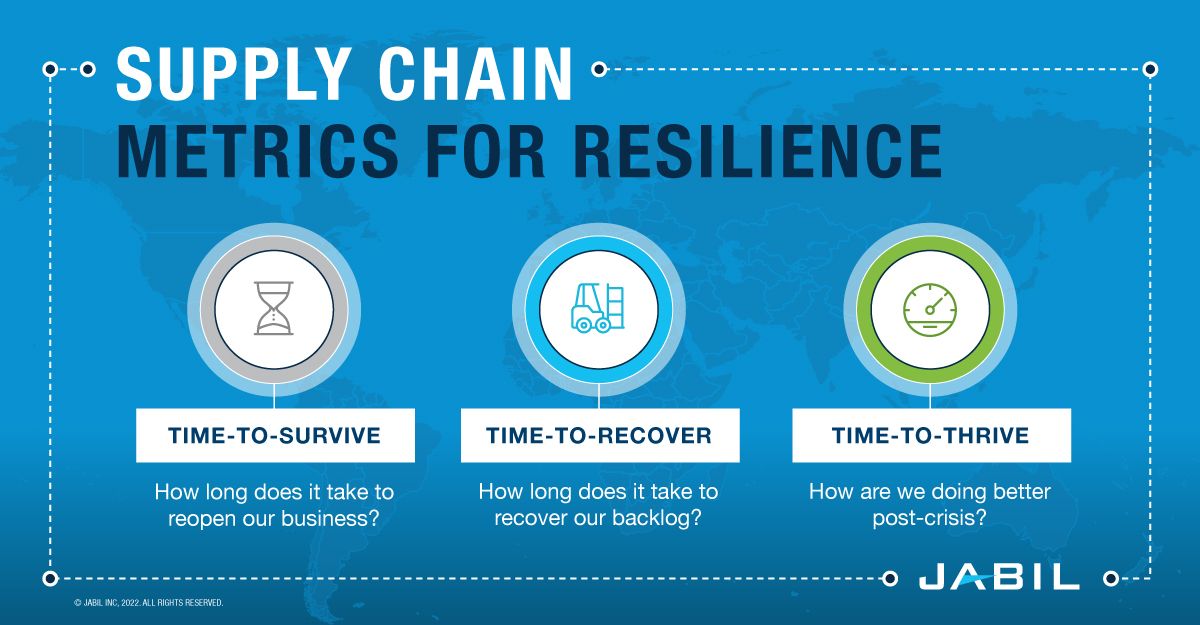
Time-to-survive refers to the amount of time it takes for your business to resume your supply chain operation after a disruption. For example, the time-to-survive for some factories in China took about three weeks after initial COVID-19 outbreaks. That's approximately how long it took to secure the necessary personal protective equipment, establish safety regulations, obtain government clearance, and re-open the factories.
There are a few questions companies need to work through in time-to-survive:
-
How do we pay people?
-
How do we get people back into the workplace?
-
Can we take corrective action to reopen our doors?
-
What is the problem? Do we understand it, and how do we resolve it?
Essentially, time-to-recover is the time it takes you to recover all your backlog. Even though the Chinese factories were functioning again in less than a month, they were running at a fraction of their normal capacity because of lost time and a lack of workers. As a result, it took about three or four months to recover their backlogs.
Time-to-thrive is an evaluation of the company after it has emerged from a crisis. It compares the states of the company pre- and post-crisis and asks, "How are we stronger now because of what we learned during the supply chain disruption, and how have we changed in response?"
Companies that navigate volatile supply chains and turbulent market conditions and adjust their strategies to be more prepared in the future can emerge from disruptions with a win. To do this, they need to pivot their services to match what the market really needs as opposed to what it needed before. Because of this, they can earn more business. This is where supply chain resilience makes a difference.
How can ww5 help your team build supply chain resilience?
Contact us.